mastering physics 13


A)Find the kinetic energy
We can use the result from Part A to study a process of interestin atomic physics: a collision of two atoms that causes one of theatoms to ionize (lose anelectron). In this case, is the energy needed to ionize one ofthe atoms,called the ionization energy. The most efficient way toionize an atom in a collision with another atom is for thecollision to be completelyinelastic (atoms stick together afterthe collision). If the collision were perfectly elastic, thentranslational kinetic energy would be conserved, and therewould beno energy left over for exciting the atom. If the collision werepartially elastic, then some of the initial kinetic energy would beconverted intointernal energy, but not as much as in a perfectlyinelastic collision. In practice, interatomic collisions are neverperfectly inelastic, but analyzing thiscase can give a lower boundon the amount of kinetic energy needed for ionization.
Is it possible to ionize an atom of , initially at rest, by a collision with an atom of
that has kinetic energy
of 4.0 electron volts? The ionization energy of thecesium atom is 3.9 electronvolts.
You can take the mass of the oxygen atom to be 16 atomic massunits and that of the cesium atom to be 133 atomic mass units. Itdoesn't matter what mass unitsyou choose, as long as you areconsistent. For this question, it is most convenient to use atomicmass units, since these are the numbers you are provided with.
| ||||||
| Correct | ||||||


Part CWhat is the least possible initial kineticenergy
Homework Answers

> Also where is the final answer coming from? How did you derive that from what you found for Kf? This is seriously undersimplified.
Nuttmastah Wed, Oct 27, 2021 7:04 PM


Be3+ is a one-electron ion. It is a beryllium atom that has lost 3 of its...
Be3+ is a one-electron ion. It is a beryllium atom that has lost 3 of its electrons. Minimum energy of a photon that would ionize this ion= -217.6 eV The wavelength of the photon that would excite Be3+ from its ground state to its first excited state= 7.56 nm Calculate the kinetic energy of the photoelectrons if radiation of 4.0 nm of wavelength falls on an ensemble of Be3+ ions.
Calculate the energy of a photon required to excite a hydrogen atom from the n =...
 Calculate the energy of a photon required to excite a hydrogen
atom from the n = 1 state to the n = 2 state.
10. [1pt] Calculate the energy of a photon required to excite a hydrogen atom from the - 1 state to the n - 2 state, Answer: Submit All Answers 11. [1pt] An electron in a hydrogen atom falls to an energy level n = 2. If the wavelength of the emitted electromagnetic radiation is 4.86x10m, what...
Calculate the energy of a photon required to excite a hydrogen
atom from the n = 1 state to the n = 2 state.
10. [1pt] Calculate the energy of a photon required to excite a hydrogen atom from the - 1 state to the n - 2 state, Answer: Submit All Answers 11. [1pt] An electron in a hydrogen atom falls to an energy level n = 2. If the wavelength of the emitted electromagnetic radiation is 4.86x10m, what...
Match each definition with the appropriate name. Choices: absorption, emission, excited state, ionization, ground state, transition....
Match each definition with the appropriate name. Choices: absorption, emission, excited state, ionization, ground state, transition. • any energy state of an atom except the ground state. • the lowest energy state of an atom. • a photon of light causes an electron to jump to a higher energy state. • a photon strikes an atomic electron and removes it from the atom. • an electron falls to a lower energy state and a photon is created. • a jump...
05 Question (4 points) When a hydrogen atom absorbs a photon of electromagnetic radiation (EMR), the...
 05 Question (4 points) When a hydrogen atom absorbs a photon of electromagnetic radiation (EMR), the internal energy of the atom increases and one or more electrons may be energized into an excited state. The release of this extra energy as the excited state electron transitions back to a lower energy state results in the emission of a photon. These energy changes are responsible for the emission spectrum of hydrogen (shown below) and are described by the Bohr equation. AE...
A neutron in a reactor makes an elastic head on collision with the nucleus of an...
A neutron in a reactor makes an elastic head on collision with the nucleus of an atom initially at rest. Assume: The mass of the atomic nucleus is about 13.7 the mass of the neutron. a)What fraction of the neutron’s kinetic energy is transferred to the atomic nucleus? b)If the initial kinetic energy of the neutron is 1.93 × 10⁻¹³ J, find its final kinetic energy. Answer in units of J.
Successive ionization energies are not represented in the experimental photoelectron spectra. It’s important to realize that...
 Successive ionization energies are not
represented in the experimental photoelectron spectra. It’s
important to realize that PES simply shows the energies required to
photoionize ONE electron from a neutral atom. In the case of the
nitrogen PES spectrum you examined in section, the one electron
photoionized can be from the 1s, 2s or 2p subshell in its ground
state.
In contrast, successive
ionization energies correspond to the removal of
more than one electron from a given atom. These
electrons are...
Successive ionization energies are not
represented in the experimental photoelectron spectra. It’s
important to realize that PES simply shows the energies required to
photoionize ONE electron from a neutral atom. In the case of the
nitrogen PES spectrum you examined in section, the one electron
photoionized can be from the 1s, 2s or 2p subshell in its ground
state.
In contrast, successive
ionization energies correspond to the removal of
more than one electron from a given atom. These
electrons are...
11. Saha equation for a generic atom. (a) Work out the analog of equation (11.41) for...
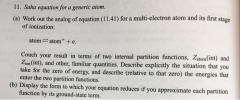 11. Saha equation for a generic atom. (a) Work out the analog of equation (11.41) for a multi-electron atom and its first stage of ionization: atom atome Couch your result in terms of two internal partition functions, Zatom(int) and Zion(int), and other, familiar quantities. Describe explicitly the situation that you take for the zero of energy, and describe (relative to that zero) the energies that enter the two partition functions. (b) Display the form to which your equation reduces if...
016 (part 1 of 2) 10.0 points A neutron in a reactor makes an elastic headon...
016 (part 1 of 2) 10.0 points A neutron in a reactor makes an elastic headon collision with the nucleus of an atom initially at rest. Assume: The mass of the atomic nucleus is about 13.7 the mass of the neutron. What fraction of the neutron’s kinetic energy is transferred to the atomic nucleus? 017 (part 2 of 2) 10.0 points If the initial kinetic energy of the neutron is 8.06 × 10⁻¹³ J, find its final kinetic energy. Answer...
Suppose that an electron is trapped in a one- dimensional, infinite potential well of width 250...
 Suppose that an electron is trapped in a one- dimensional, infinite potential well of width 250 nm is excited from the 2nd excited state to the fifth excited state. What energy must be transferred to the electron in order to make this transition? Answer: 1.62 x 10^-4 eV Check Correct Marks for this submission: 2.00/2.00. What wavelength photon does this correspond to? Answer: 75.15*10^-4m Check Considering all of the possible ways that the excited electron can de-excite back down to...
A. The wavelength of the yellow light emitted by the 3p-3s transition in sodium is 590...
 A. The wavelength of the yellow light emitted by the 3p-3s
transition in sodium is 590 nm. What is the energy of the emitted
photon?
2.1000 eV
You are correct.
Your receipt no. is 161-7103
Previous Tries
B. The probability of finding an atom at an excited state
(relative to the probability of finding the atom in the ground
state) is given by P=e−(ΔEkBT) At room temperature (T ∼ 300 K),
what is the relative probability (compared to being in...
A. The wavelength of the yellow light emitted by the 3p-3s
transition in sodium is 590 nm. What is the energy of the emitted
photon?
2.1000 eV
You are correct.
Your receipt no. is 161-7103
Previous Tries
B. The probability of finding an atom at an excited state
(relative to the probability of finding the atom in the ground
state) is given by P=e−(ΔEkBT) At room temperature (T ∼ 300 K),
what is the relative probability (compared to being in...
 Calculate the energy of a photon required to excite a hydrogen
atom from the n = 1 state to the n = 2 state.
10. [1pt] Calculate the energy of a photon required to excite a hydrogen atom from the - 1 state to the n - 2 state, Answer: Submit All Answers 11. [1pt] An electron in a hydrogen atom falls to an energy level n = 2. If the wavelength of the emitted electromagnetic radiation is 4.86x10m, what...
Calculate the energy of a photon required to excite a hydrogen
atom from the n = 1 state to the n = 2 state.
10. [1pt] Calculate the energy of a photon required to excite a hydrogen atom from the - 1 state to the n - 2 state, Answer: Submit All Answers 11. [1pt] An electron in a hydrogen atom falls to an energy level n = 2. If the wavelength of the emitted electromagnetic radiation is 4.86x10m, what...
 05 Question (4 points) When a hydrogen atom absorbs a photon of electromagnetic radiation (EMR), the internal energy of the atom increases and one or more electrons may be energized into an excited state. The release of this extra energy as the excited state electron transitions back to a lower energy state results in the emission of a photon. These energy changes are responsible for the emission spectrum of hydrogen (shown below) and are described by the Bohr equation. AE...
 Successive ionization energies are not
represented in the experimental photoelectron spectra. It’s
important to realize that PES simply shows the energies required to
photoionize ONE electron from a neutral atom. In the case of the
nitrogen PES spectrum you examined in section, the one electron
photoionized can be from the 1s, 2s or 2p subshell in its ground
state.
In contrast, successive
ionization energies correspond to the removal of
more than one electron from a given atom. These
electrons are...
Successive ionization energies are not
represented in the experimental photoelectron spectra. It’s
important to realize that PES simply shows the energies required to
photoionize ONE electron from a neutral atom. In the case of the
nitrogen PES spectrum you examined in section, the one electron
photoionized can be from the 1s, 2s or 2p subshell in its ground
state.
In contrast, successive
ionization energies correspond to the removal of
more than one electron from a given atom. These
electrons are...
 11. Saha equation for a generic atom. (a) Work out the analog of equation (11.41) for a multi-electron atom and its first stage of ionization: atom atome Couch your result in terms of two internal partition functions, Zatom(int) and Zion(int), and other, familiar quantities. Describe explicitly the situation that you take for the zero of energy, and describe (relative to that zero) the energies that enter the two partition functions. (b) Display the form to which your equation reduces if...
 Suppose that an electron is trapped in a one- dimensional, infinite potential well of width 250 nm is excited from the 2nd excited state to the fifth excited state. What energy must be transferred to the electron in order to make this transition? Answer: 1.62 x 10^-4 eV Check Correct Marks for this submission: 2.00/2.00. What wavelength photon does this correspond to? Answer: 75.15*10^-4m Check Considering all of the possible ways that the excited electron can de-excite back down to...
 A. The wavelength of the yellow light emitted by the 3p-3s
transition in sodium is 590 nm. What is the energy of the emitted
photon?
2.1000 eV
You are correct.
Your receipt no. is 161-7103
Previous Tries
B. The probability of finding an atom at an excited state
(relative to the probability of finding the atom in the ground
state) is given by P=e−(ΔEkBT) At room temperature (T ∼ 300 K),
what is the relative probability (compared to being in...
A. The wavelength of the yellow light emitted by the 3p-3s
transition in sodium is 590 nm. What is the energy of the emitted
photon?
2.1000 eV
You are correct.
Your receipt no. is 161-7103
Previous Tries
B. The probability of finding an atom at an excited state
(relative to the probability of finding the atom in the ground
state) is given by P=e−(ΔEkBT) At room temperature (T ∼ 300 K),
what is the relative probability (compared to being in...
Most questions answered within 3 hours.
-
Where is the error in this code sequence?
String s1 = "Hello";
String s2 = "ello";...
asked 10 months ago -
Financial data for Joel de Paris, Inc., for last year
follow:
Joel de Paris, Inc.
Balance...
asked 10 months ago -
Consider this reaction:
Al2(SO4)3 (aq)+ BaCl3
(aq) Al2Cl6 (aq)- +
3BaSO4(s) . What is the...
asked 10 months ago -
Suppose that Savneet is considering increasing her
recent random sample from 20 car rentals to 40...
asked 10 months ago -
Trucks arrive at an unloading terminal at an average rate of 120
per hour.
Trucks arrive...
asked 10 months ago -
Why are methanol and ethanol completely soluble in water while
octanol is not very little soluble....
asked 10 months ago -
A facilities manager at a university reads in a research report
that the mean amount of...
asked 10 months ago -
When the CuSO4 is rehydrated by adding water to the anhydrous
compound, is this an endothermic...
asked 10 months ago -
A ray of sunlight is passing from diamond into crown glass; the
angle of incidence is...
asked 10 months ago -
A block of mass 0.249 kg is placed on top of a light, vertical
spring of...
asked 10 months ago -
how do the kidneys compensate in the presences of acidosis
a) trigger hyperventilate
b) reserve acid...
asked 10 months ago -
Question 501 pts
The rental rate of capital to the firm increases. Which of the
following...
asked 10 months ago
> "Using formula for kinetic energy eliminated vi from previous step?" Where? When? Why? Explain please.
Nuttmastah Wed, Oct 27, 2021 6:51 PM